Fiduciary duty
ERISA Fiduciary Duty and Payment Integrity: What Employers and Carriers Should Know
Improper health plan payments cost over $100 billion annually, and employers who fail to address payment accuracy may be breaching their ERISA fiduciary duties. Here's what employers, carriers, and TPAs need to know about payment integrity and fiduciary compliance.
4 min read
Key takeaways
- Employers that exercise discretionary control over a health plan are ERISA fiduciaries: they must act solely in participants’ interest, with the care of a prudent person.
- The duty is process-based. The Department of Labor treats selecting and monitoring service providers — insurers, TPAs, PBMs — as a fiduciary act.
- A 2026 Journal of Law, Medicine & Ethics study found employers measure on average only 3.5 of 15 key health plan performance elements; at least one third may be falling short of basic fiduciary duties.
- Payment integrity protects plan assets and documents prudent oversight. Supplemental lines — accident, critical illness, hospital indemnity — are where gaps most often go unnoticed.
Every year, billions of dollars in health insurance claims are paid incorrectly — and for employers with ERISA fiduciary obligations, that's more than an accounting problem. The Government Accountability Office (GAO) reported that Medicare and Medicaid programs alone saw over $100 billion in improper payments in 2023. These improper payments—either payments of an incorrect amount or ones that should not have been made at all—carry serious implications for the private sector. Employers sponsoring health plans cover nearly 178 million Americans and account for approximately $1.5 trillion in annual spending, and payment errors in those plans represent a potential breach of their legal duties. For the carriers and administrators overseeing those plans, the stakes are just as high.
What Are Employers' ERISA Fiduciary Obligations for Health Plans?
Under the Employee Retirement Income Security Act (ERISA), enacted by Congress in 1974, employers that exercise discretionary control over the management or administration of an employee benefit plan are considered fiduciaries. ERISA fiduciary duty requires these employers to act solely in the interest of plan participants and beneficiaries, and to undertake their duties with the care, skill, prudence, and diligence that a prudent person in a similar capacity would use. This is a process-based duty: employers must conduct thorough research, comparison shop for service providers, ensure fees are reasonable, and monitor performance at regular intervals. The Department of Labor has stated that selecting a service provider—including an insurer, TPA, or pharmacy benefits manager—is itself a fiduciary act.
This also means employers cannot turn a blind eye to inflated claims or wasteful spending by the plans they select. Yet, a 2026 study by Richman, Monahan, Pfeffer, and Singer in the Journal of Law, Medicine & Ethics found that many employers are doing exactly that.
That failure exposes employers to legal liability while their employees shoulder unnecessarily high costs.
How Payment Integrity Supports ERISA Compliance
Payment integrity refers to the processes, technologies, and analytics used to ensure that health plan payments are accurate, timely, and compliant with relevant guidelines. This includes identifying overpayments before or after claims are processed, detecting patterns of fraud, waste, and abuse (FWA), and recovering funds that were disbursed improperly.
A robust payment integrity program does more than protect carriers from overspending. It directly supports employers' ERISA fiduciary obligations by:
- Reducing unnecessary costs that would otherwise be passed on to plan members through higher contributions or cost-sharing.
- Detecting fraud and abuse that erodes plan assets and undermines trust in the health care system.
- Ensuring accurate provider reimbursement, so that plan funds are spent according to the terms members and sponsors agreed to.
Why Supplemental Benefit Carriers Need Prepayment Integrity
For carriers and Third-Party Administrators (TPAs), these findings should be a wake-up call. If employers are under growing legal pressure to select and monitor service providers more rigorously, carriers that can demonstrate strong payment integrity controls become far more attractive choices.
Health care costs continue to rise, and regulatory scrutiny of plan administration is intensifying. Although major medical claims often get the most attention, supplemental health benefits — accident, critical illness, hospital indemnity, and similar lines — are an area where payment integrity gaps frequently go unnoticed. These products are growing fast, and without proper prepayment controls, overpayments and billing errors can undermine plan value.
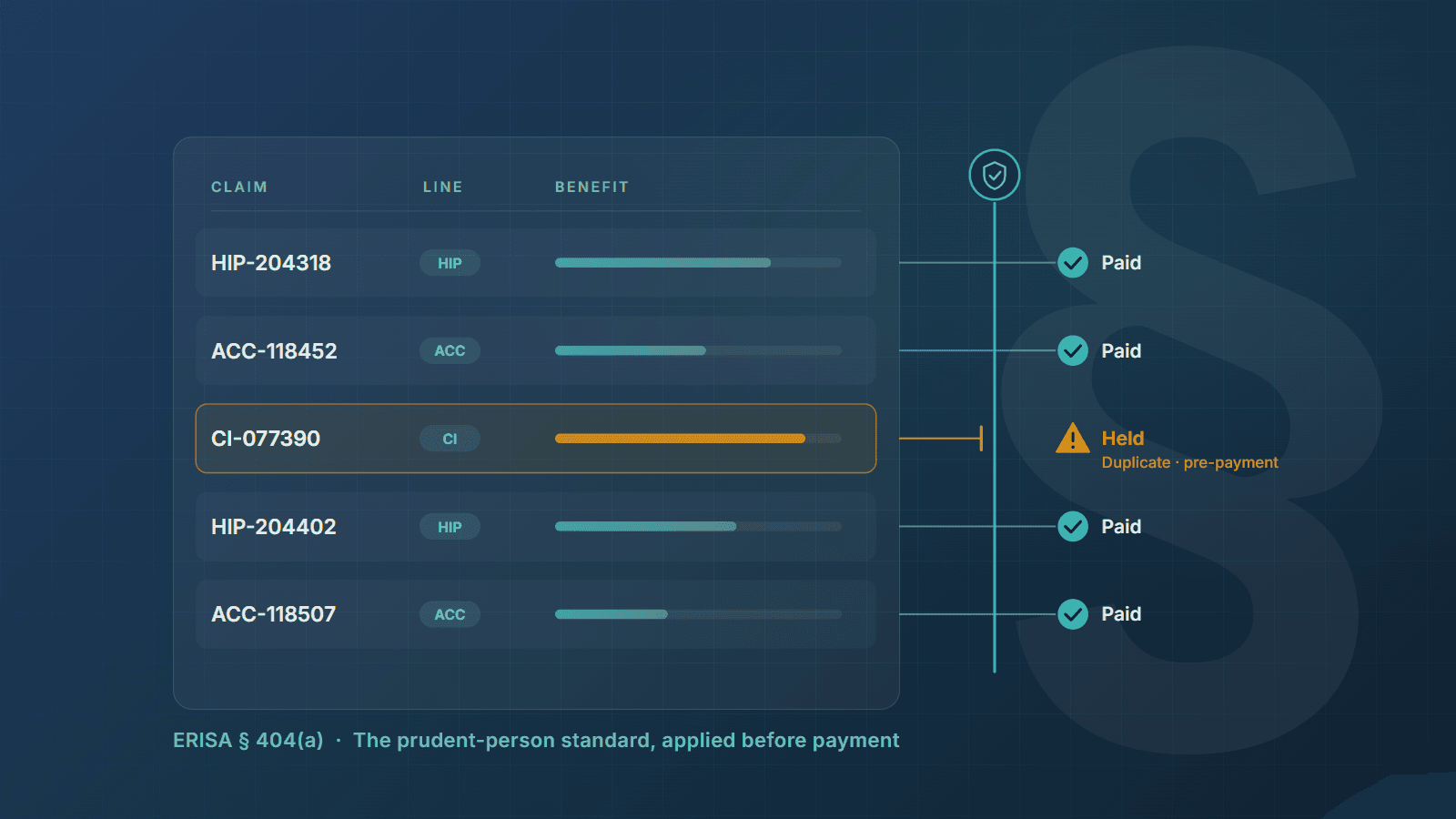
That's where solutions like Trestl come in. Trestl is building the prepayment integrity standard that supplemental benefit insurers have been missing. The Trestl platform validates Hospital Indemnity, Accident, and Critical Illness claims before payment occurs—catching overpayments, underpayments, duplicates, and fraud that post-pay recovery may not find. For carriers looking to strengthen their fiduciary posture, reduce recovery costs, and deliver real value to plan sponsors, investing in prepayment accuracy is the right call.
Frequently asked questions
- Who is an ERISA fiduciary for an employer health plan?
- Under ERISA, an employer that exercises discretionary control over the management or administration of an employee benefit plan is a fiduciary. It must act solely in the interest of plan participants and beneficiaries, with the care, skill, prudence, and diligence a prudent person in a similar capacity would use.
- Is choosing an insurer or TPA a fiduciary decision?
- Yes. The Department of Labor has stated that selecting and monitoring service providers for a group health plan — including an insurer, third-party administrator, or pharmacy benefits manager — is a fiduciary act subject to ERISA’s prudence and loyalty duties.
- How does payment integrity support ERISA compliance?
- Payment integrity checks that claims are paid accurately and only when they should be. It reduces costs that would otherwise pass to plan members, detects fraud and abuse that erode plan assets, and ensures plan funds are spent according to plan terms — evidence that the plan is being monitored prudently.
- Why does prepayment integrity matter for supplemental benefits?
- Accident, critical illness, and hospital indemnity lines are growing quickly, and payment errors there frequently go unnoticed because attention centers on major medical. Validating claims before payment stops overpayments, duplicates, and fraud before money leaves the plan, rather than relying on recovery after the fact.
Sources
- U.S. Government Accountability Office (2024). Medicare and Medicaid: Additional Actions Needed to Enhance Program Integrity and Save Billions (GAO-24-107487)
- Journal of Law, Medicine & Ethics (2026). ERISA and the Failure of Employers to Perform Their Fiduciary Duties: Evidence from a Survey of Health Plan Administrators (Richman, Monahan, Pfeffer, Singer), vol. 54, no. 1
- Congress.gov (1974). H.R. 2 — Employee Retirement Income Security Act of 1974
- U.S. Departments of Labor, Treasury, and Health and Human Services (2015). Summary of Benefits and Coverage and Uniform Glossary, 80 Fed. Reg. (June 16, 2015)
- The Regulatory Review (2025). Regulating Health Care Plan Fiduciaries
- The Regulatory Review (2026). Justifying the Cost of Voluntary Benefits
- Buchanan Ingersoll & Rooney PC (2026). New Wave of ERISA Class Action Lawsuits Name Brokers as Defendants